 239 444 7833239 444 7833
53 pieces across 22 collections. Solid European oak, built to order in 10–16 weeks.
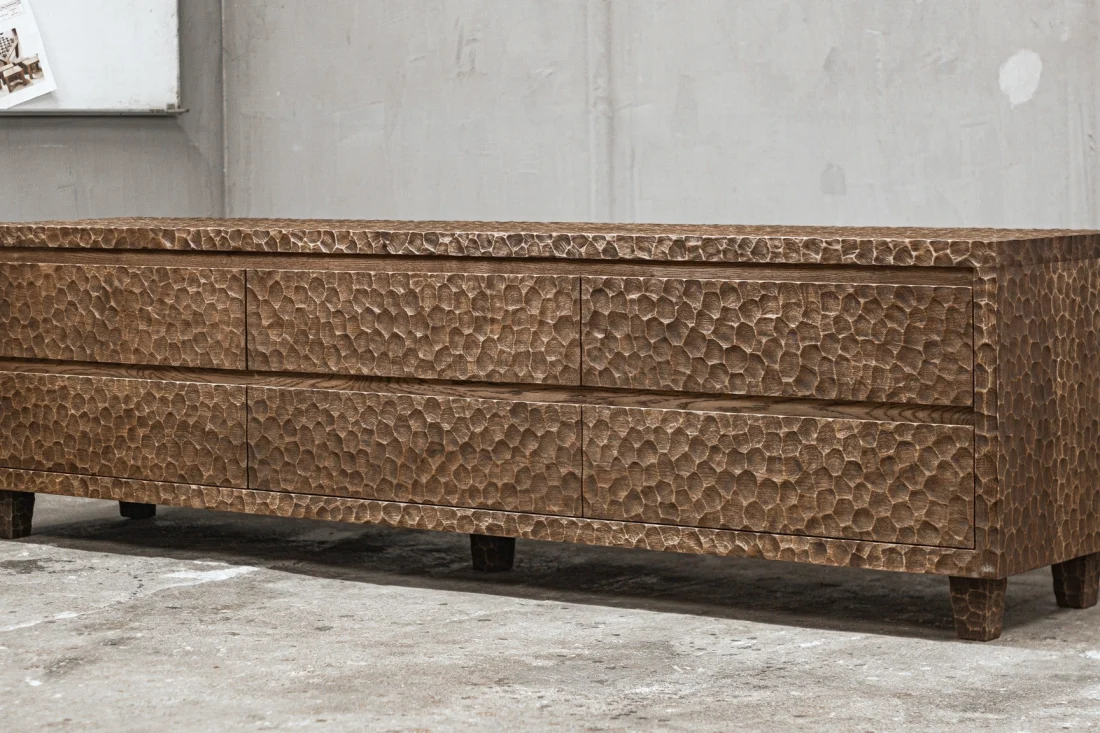
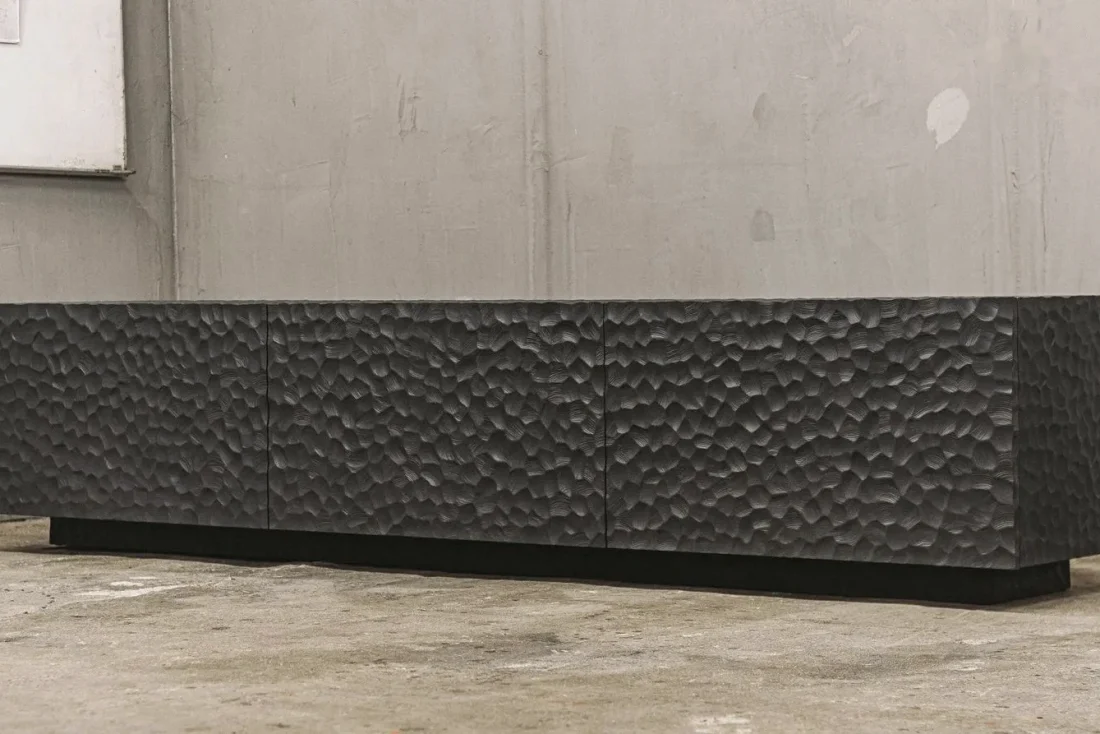
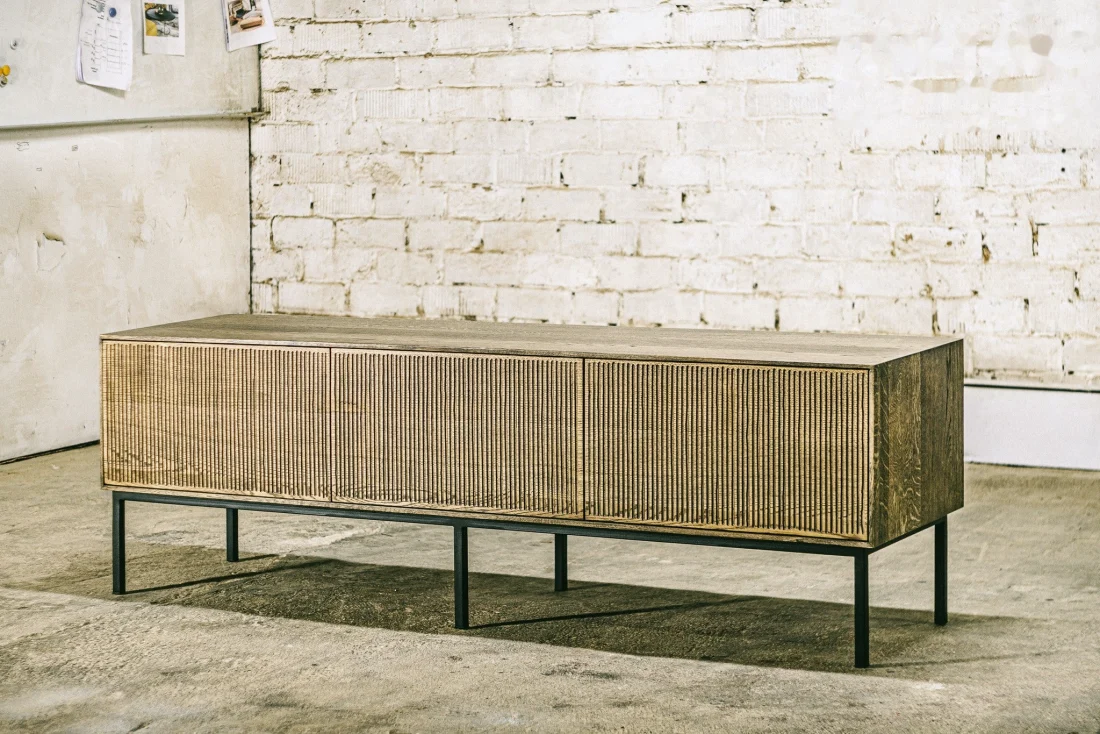
Biscayne Bay catches the sun in constantly shifting texture, no two patches of water lit quite the same, and this console's face does something similar — a deep, hand-worked texture across solid oak, hammered or dimpled so light catches differently panel to panel rather than lying flat.
Across the eight pieces, the frame is oak or oak on black steel, with the walnut-toned wood taking the textured treatment on drawer fronts while the case stays plain. Lengths run from a compact media stand to one stretching over ten feet. Set below a television or along a long wall, the texture reads from across a room the way a plain oak grain would not — a piece that keeps giving something to look at once the screen is off.
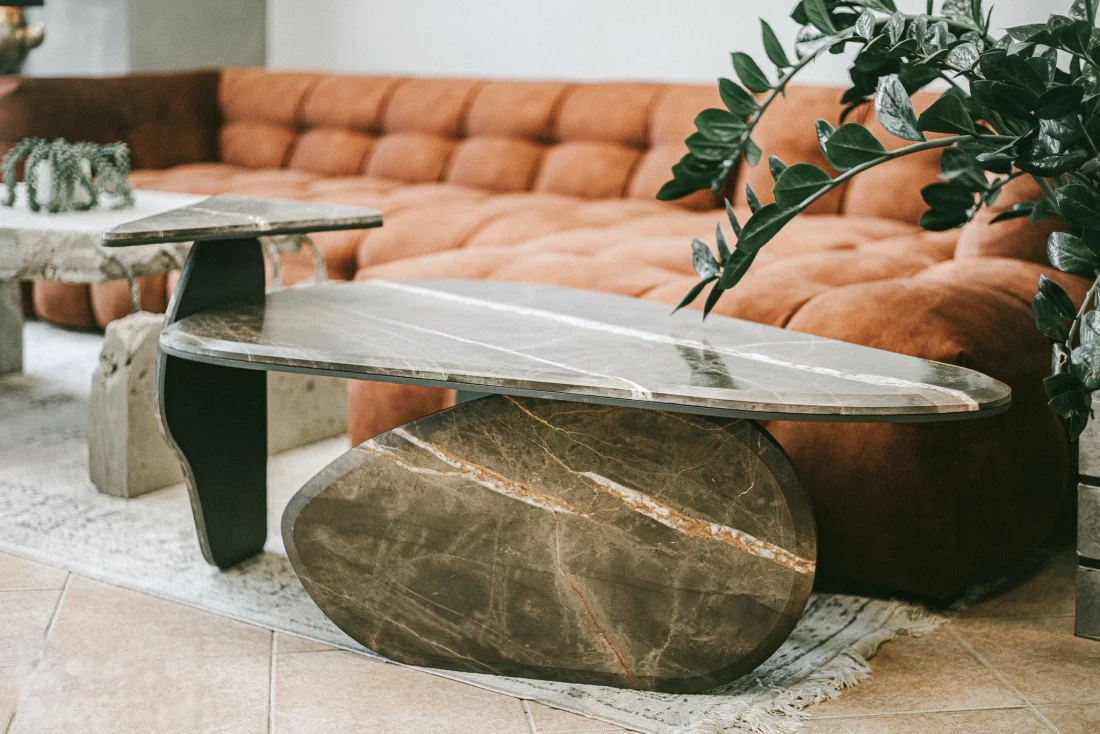
Red rock country wears its boulders out in the open, rounded by wind rather than carved by hand, and this table's base does the same: a solid, organically shaped support in concrete or marble, holding up an oval oak or stone top with no visible joinery between the two.
Sizes and heights vary enough that two placed together read as a pair of boulders rather than a matched set. Set in front of a sofa, the base reads as sculpture that happens to hold a table up, not the other way around. It suits a room that already leans warm — rust, terracotta, deep greens — since the stone-toned base pulls those colors down toward the floor. No two bases weigh quite the same either, which keeps each piece feeling more found than manufactured.
Ojai sits in a valley known for unusually clean, still light, and this console keeps to that same calm register — a long, low run of solid oak in a natural tone, flush doors, no hardware on display, legs set at a slight outward angle for stability rather than style.
Six sizes make up the collection, some on oak legs alone and others lifted on a black steel frame, but the restraint holds across all of them: no carving, no applied texture, just good proportion and a warm, natural finish. Nothing on the piece asks to be noticed before the room around it. It suits a room already doing enough visually — a piece meant to hold a television and disappear, rather than compete with whatever else is on the wall.
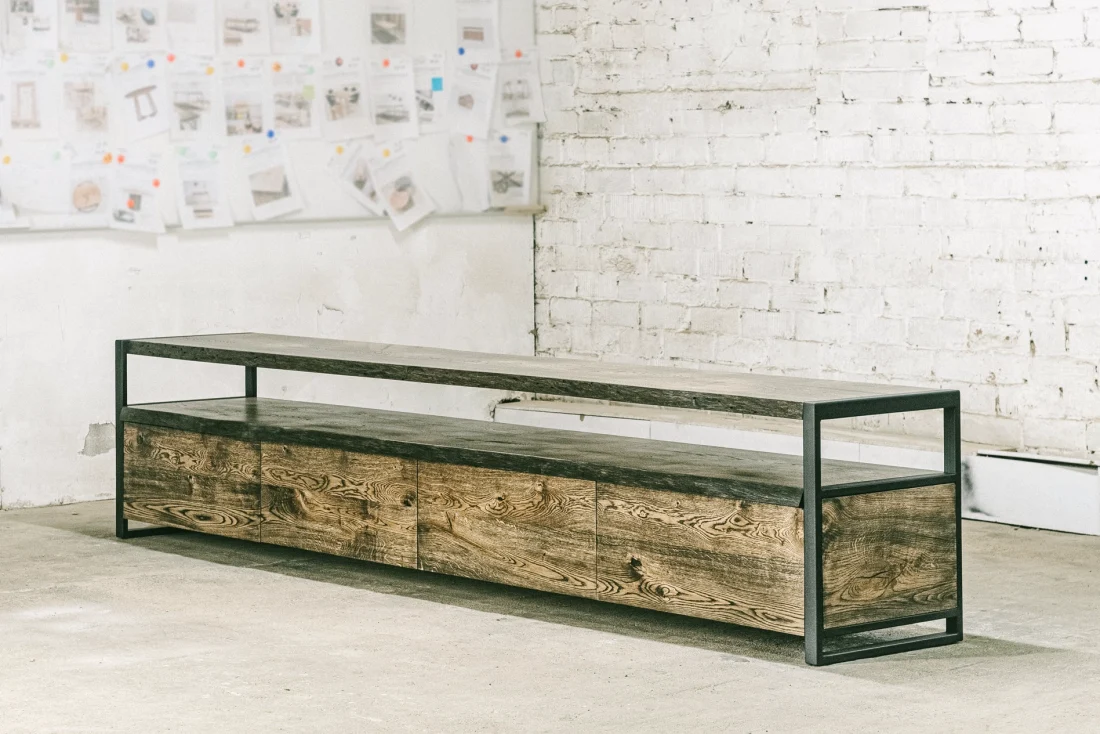
Trieste sits where the Adriatic runs unusually deep and dark right up to the shoreline, and this console takes that same deep, near-black tone — solid oak finished in a dark, almost olive-black stain, built as a run of open cubbies rather than closed doors.
Five sizes make up the collection, from a compact unit to one stretching well past six feet, but the finish and the open-box construction hold constant throughout. Without doors, the piece reads lighter than its dark color would suggest, each compartment visible and easy to reach into rather than hidden. Set below a television or along a media wall, the dark tone keeps it from competing with whatever is on the screen, which is precisely the job a piece like this has to do.
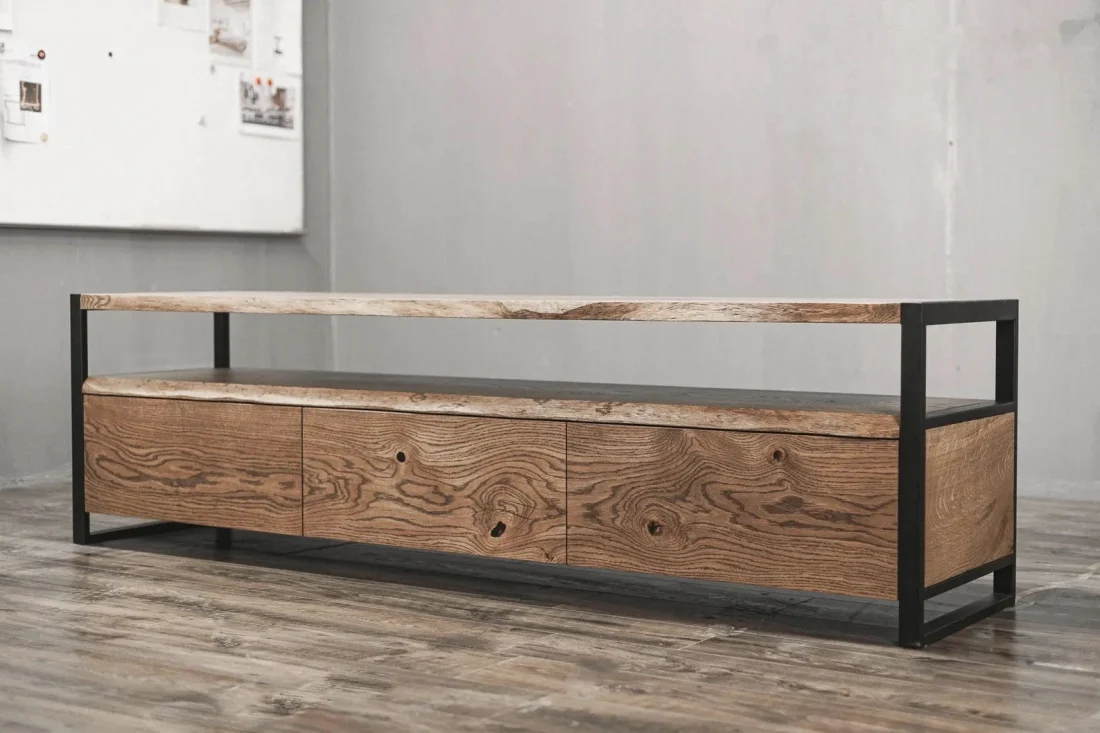
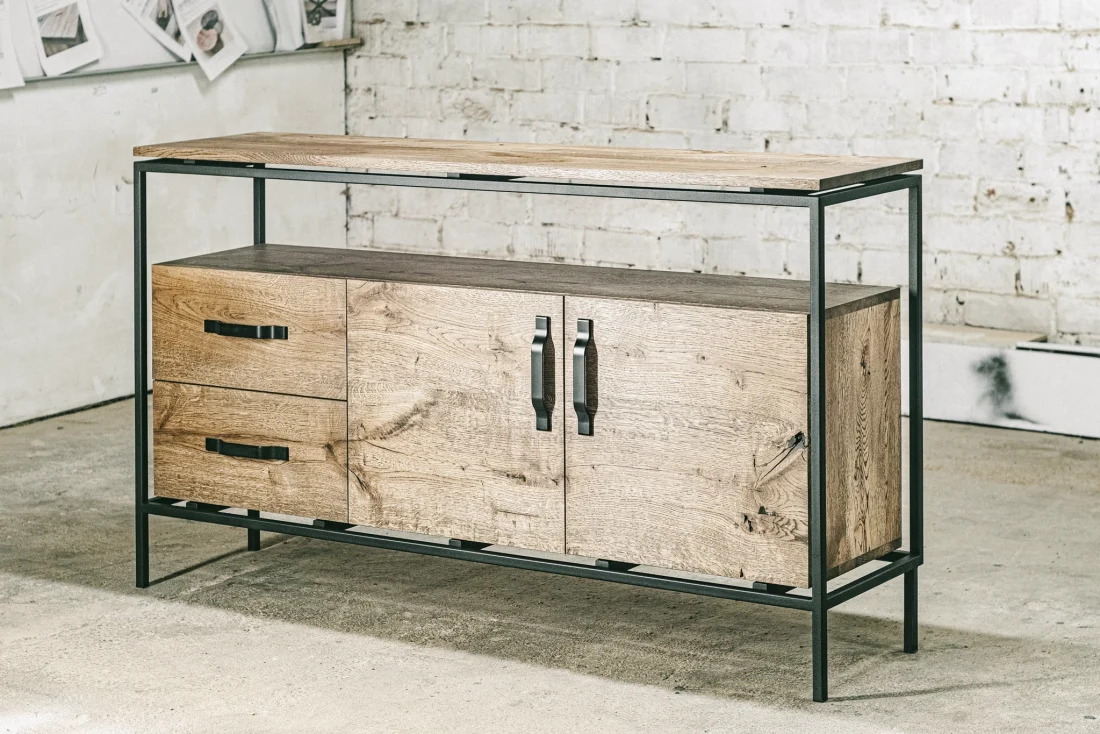
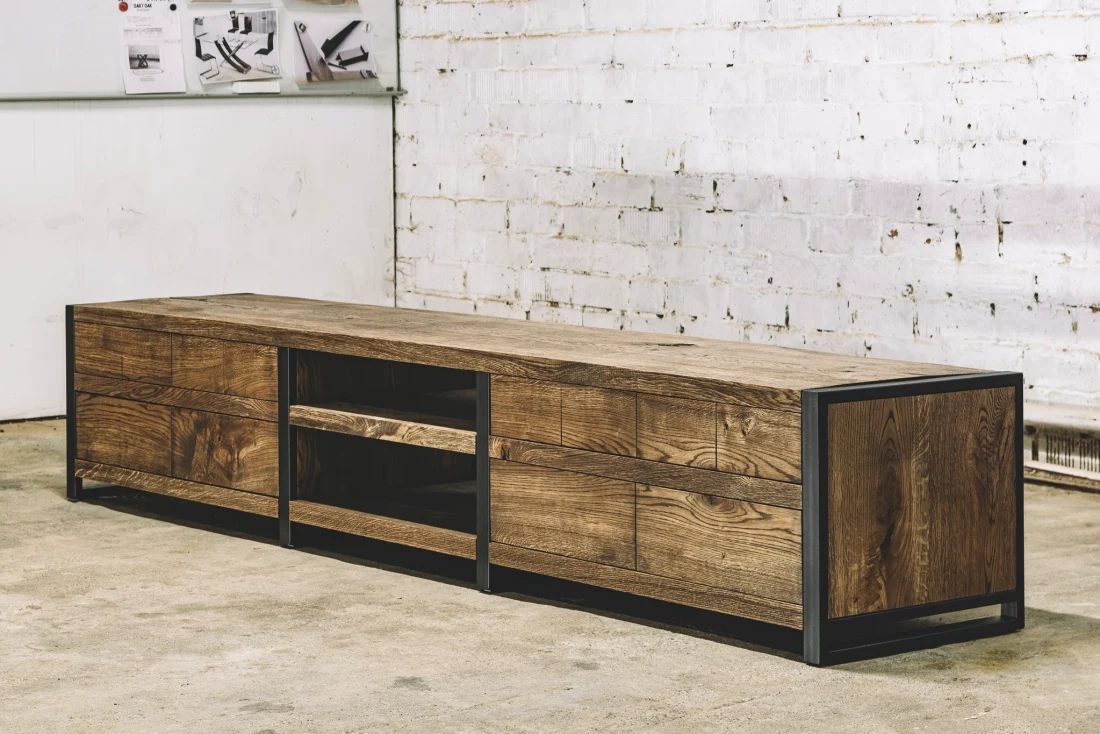
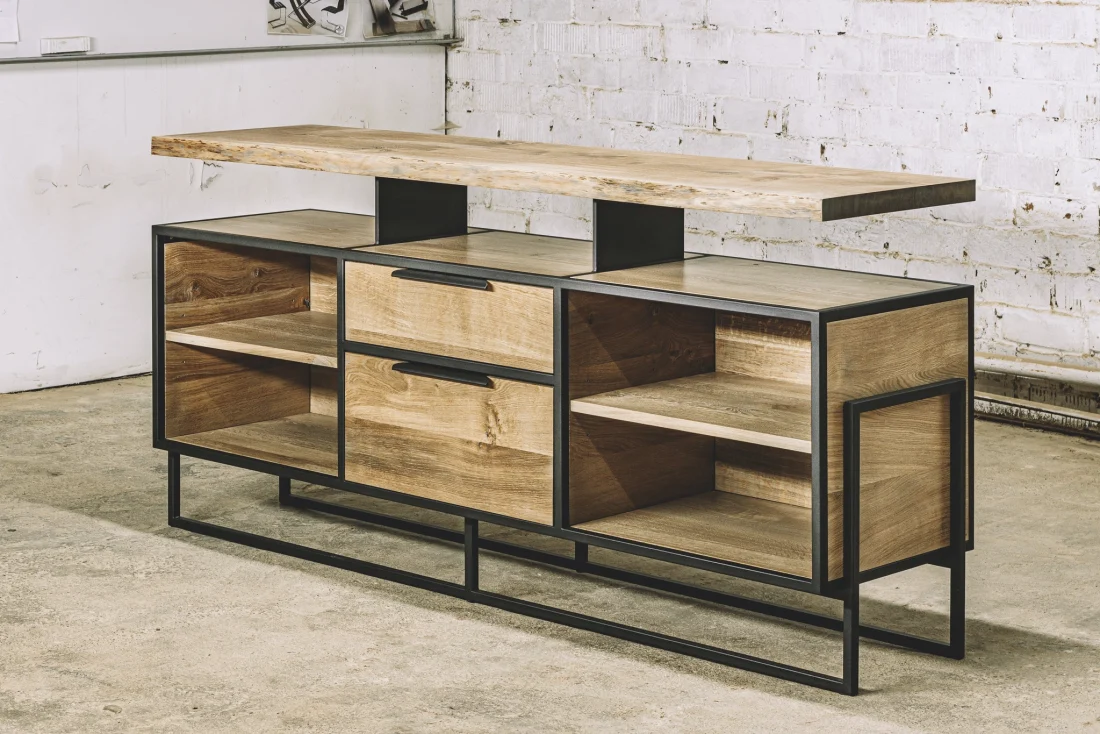
Lucca is still ringed by its old walls, slender towers rising above them at odd intervals, and this console's thin black steel frame has that same upright, minimal quality — a light structure holding oak shelving and a single drawer rather than a heavy case.
Five sizes fill out the collection, the frame staying thin and dark throughout while the oak shifts between a natural tone and a deeper walnut. Because so much of the piece is open steel rather than solid panel, it reads much lighter in a room than its length would suggest. It suits a room that wants storage without visual weight — a piece that holds what it needs to without ever blocking the wall or the window behind it.
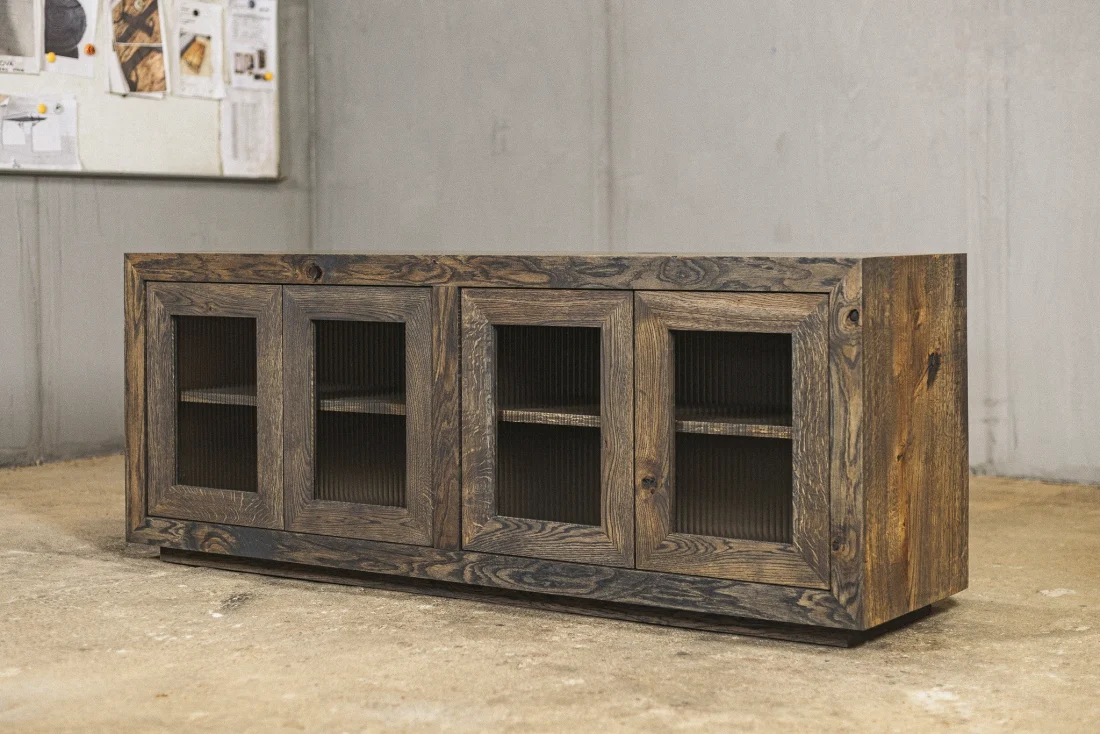
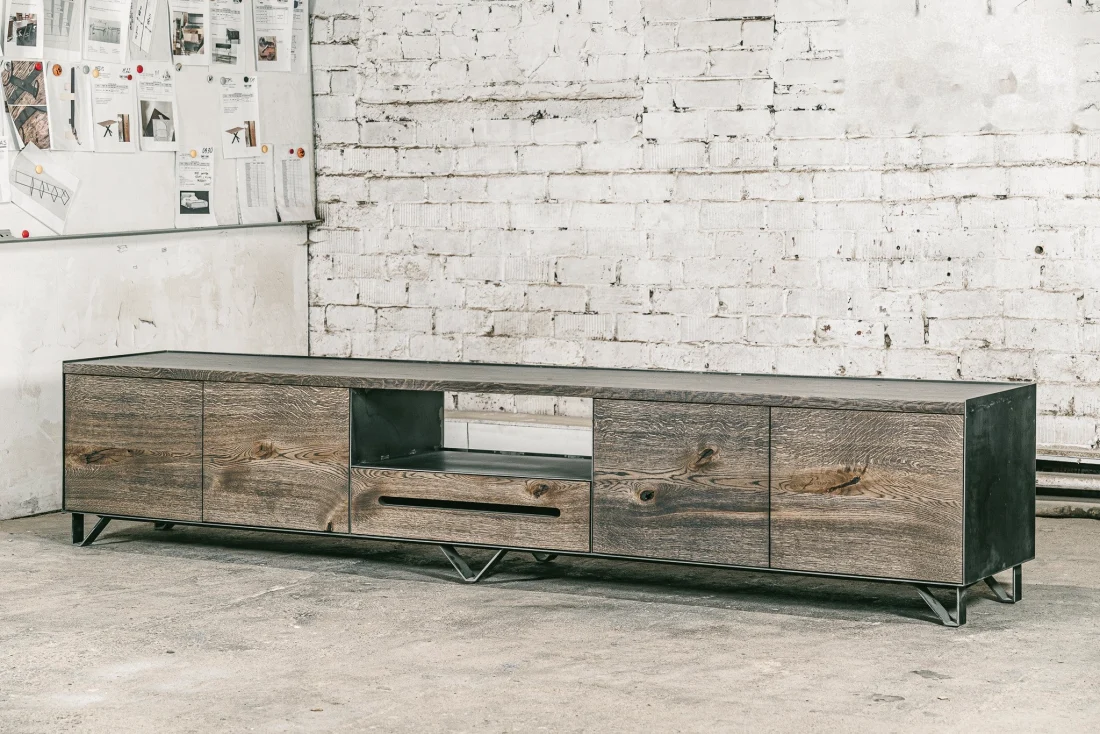
Pisa is known for stone that has weathered unevenly over centuries, and this console's door fronts have that same rough, worked texture — solid oak left in a deliberately uneven, hand-finished surface, set inside a slim black or dark green lacquered metal frame.
Four sizes make up the collection, from a compact unit to one over nine feet long, with the wood shifting between an antique tone and a darker walnut oil finish depending on the piece. The frame stays thin throughout, letting the textured doors carry the visual weight rather than the structure around them. Below a television or along a media wall, the texture keeps the piece interesting even from a distance, in a way a flat, smooth door front would not manage.
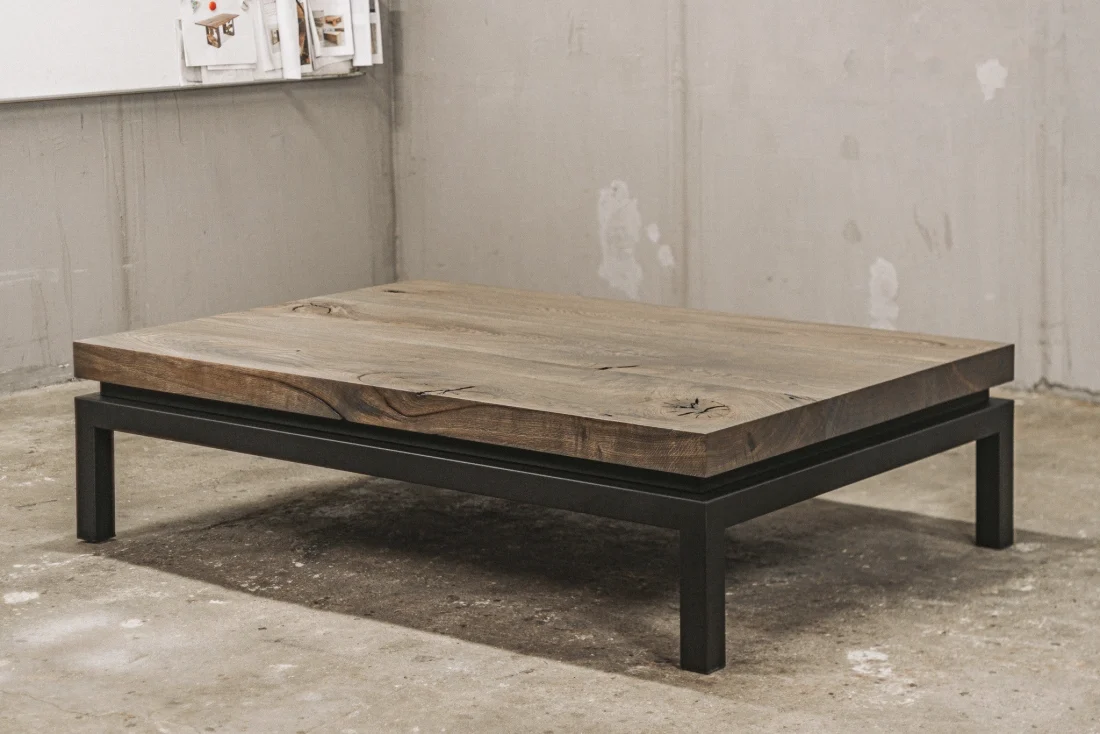
Dutch canal warehouses were built for function first, and this table follows the same instinct: a thick plank top in solid oak, natural or walnut-toned, set into a black steel box frame with no wasted material anywhere in the joinery.
Some versions add a shelf below in matching wood, others swap the top for tempered glass over the same frame. It sits low and square, built to take the daily weight of a living room without complaint — trays, feet, stacks of the mail nobody has opened yet. The steel frame is doing the structural work quietly, leaving the oak plank to be the only thing anyone actually looks at. A family gathering around it for an evening leaves exactly the kind of wear the wood is built to take.
Waves breaking along this coast gave surfers their whole vocabulary, and this set of nesting tables curves the same way: wood-grain tops on legs bent into a single sweeping arc, each table sized to tuck under the next when the room needs to open up.
A marble top replaces wood on some versions, still riding the same curved base. Pull all three out for a gathering and push them back together after — the nesting is not decorative, it genuinely collapses the footprint by half. The curve is the whole design vocabulary here: no straight leg anywhere in the set, which makes it read soft next to a room full of squarer furniture. Pulled apart for a crowd or pushed back together for a quiet evening, the set adapts to whoever shows up.
Prague earns its name from the legs, not the top — four tall, dark shapes turned and carved until they read almost architectural, the kind of ornament that used to take a craftsman a full day per leg.
Ours are oak, stained down to near-black, paired with a long, narrow top that stays deliberately plain so the base can do the talking. The collection runs to seven pieces, mostly wall consoles, one long enough to anchor an entryway, one narrower built for a hallway. All keep the same turned leg regardless of overall size. Set a lamp and a stack of books on top and let the legs be the reason people stop walking through the hall. The joinery underneath the finish is ordinary and sound, built to be leaned on for years.
Richmond's old tobacco warehouses have been rebuilt more than once, their timber reused and reassembled rather than replaced, and this console keeps that patched, reclaimed look — solid oak with visible knots and grain shifts, set into a black steel frame with an open cubby breaking up the run.
Across six pieces, wood tone varies deliberately, from natural oak to a darker walnut, so no two units look machine-matched, and the steel frame stays a constant dark line underneath. The open center section keeps a router or a stack of records visible rather than shut away. It works best in a room that already leans a little rustic, where a too-perfect piece would actually look out of place beside everything else.
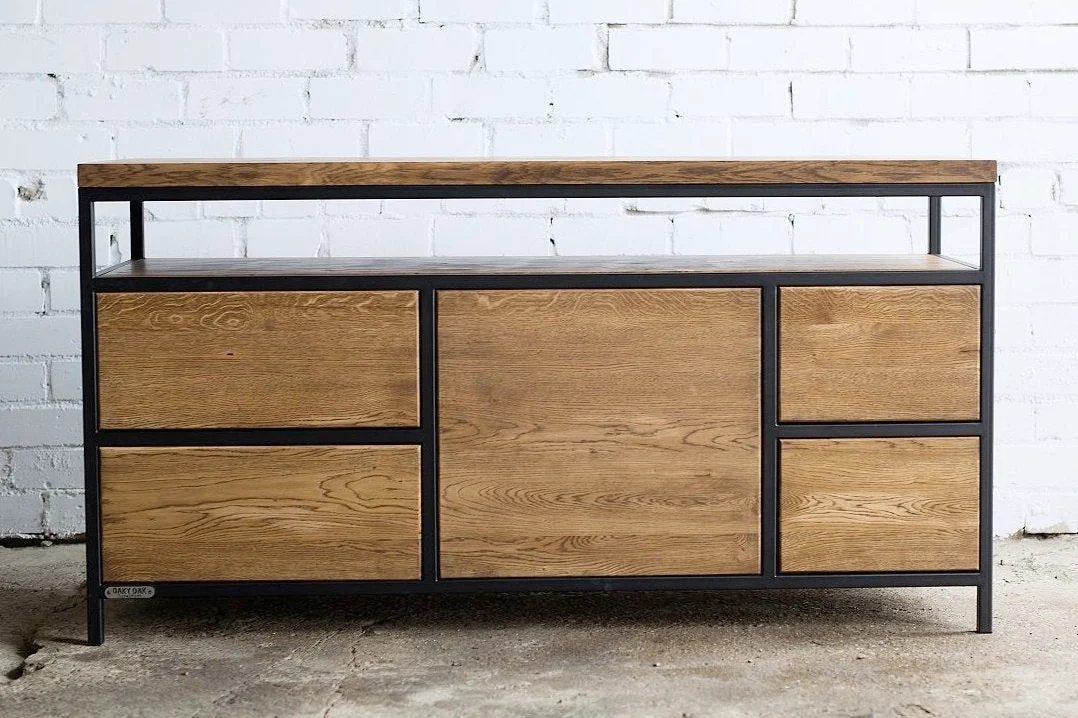
Queens is New York's patchwork borough, block after block of different textures sitting right next to each other without apology, and this media console is built the same way — a long oak case broken into alternating sections: open shelving, slatted black-framed niches, solid panels, no single rhythm repeating twice.
The carcass is light, honey-toned oak; the frame and slat inserts are finished in black metal, giving the piece a clear structural grid to organize what could otherwise feel busy. At nearly eight feet long, it reads as one console built from several different ideas rather than a repeated module. It holds a television without centering on one, since half its length is doing something else — books, a record player, whatever else lives in a living room.
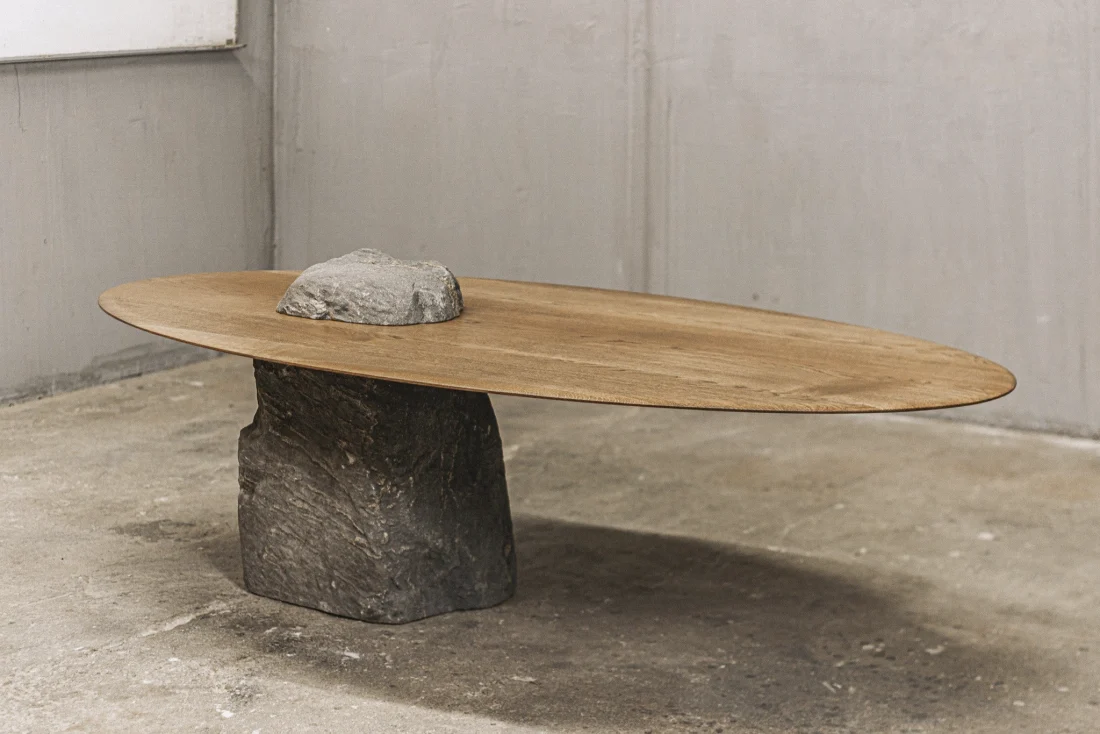
Sandstone walls rise straight out of the canyon floor in places like this, no gradual transition, and this table's base works the same way: a single natural stone support, left rough-textured, holding up a long oval top in walnut-toned oak with nothing bridging the two materials but contact.
The oval shape keeps the stone from feeling like the whole point. It reads as a found object more than a manufactured one, which makes it a natural fit in a room with a similarly organic sofa or an oversized plant nearby. There is no matching side table for this one — the stone base is too particular to repeat, and it does not need repeating. Set at the center of a seating arrangement, it pulls every other piece toward its one point of contact with the floor.
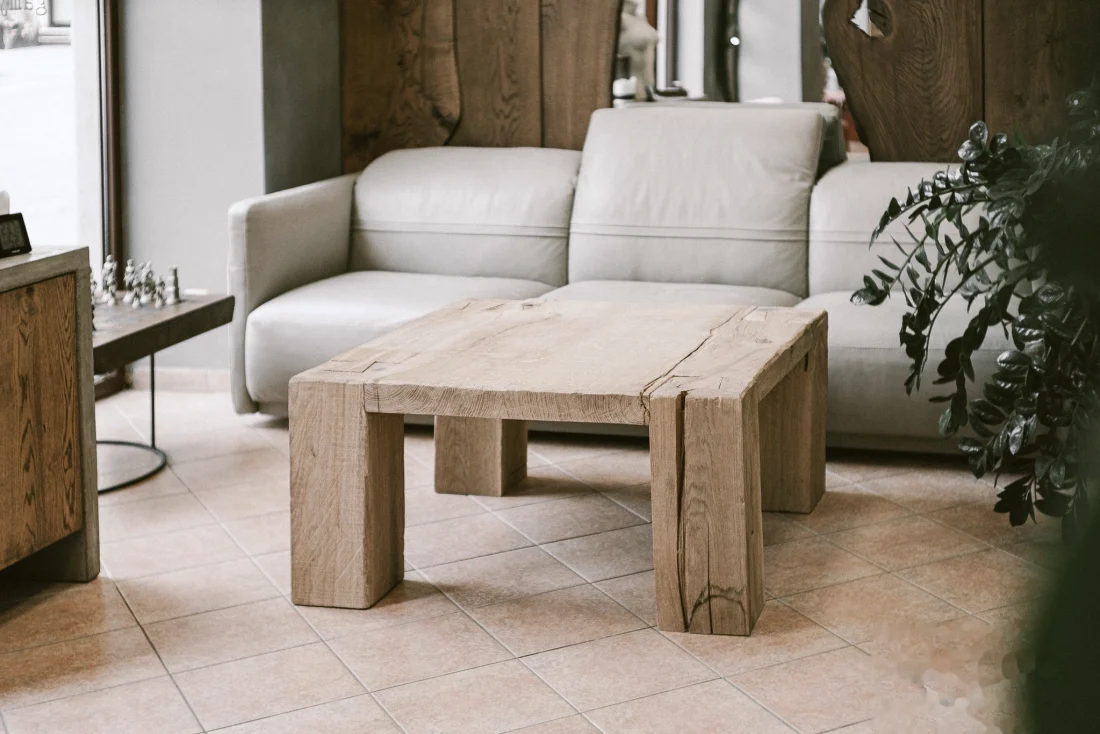
Timber-framed buildings in the Alps have always been built from beams too heavy to hide, and this table keeps that same scale: legs cut from thick, natural-edge oak, left with visible grain, cracks, and knots rather than sanded into anything uniform.
A black metal accent occasionally braces the joinery, but the wood is doing almost all the structural work itself. Sized as a nesting pair, a smaller table often tucks beside the larger one, both sharing the same heavy-beam language at different scales. It suits a room that wants furniture with genuine weight to it — not visual weight, actual weight, the kind you notice the first time you try to move it alone. Two people, not one, is the realistic way to reposition it once it has found its spot.
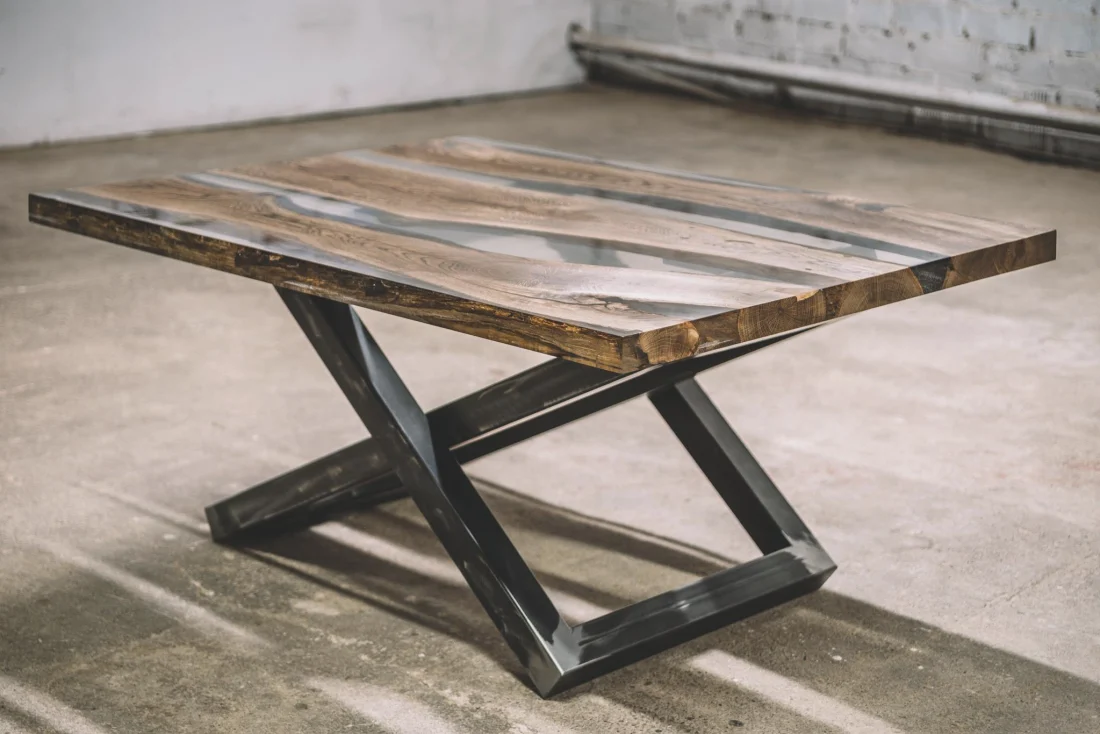
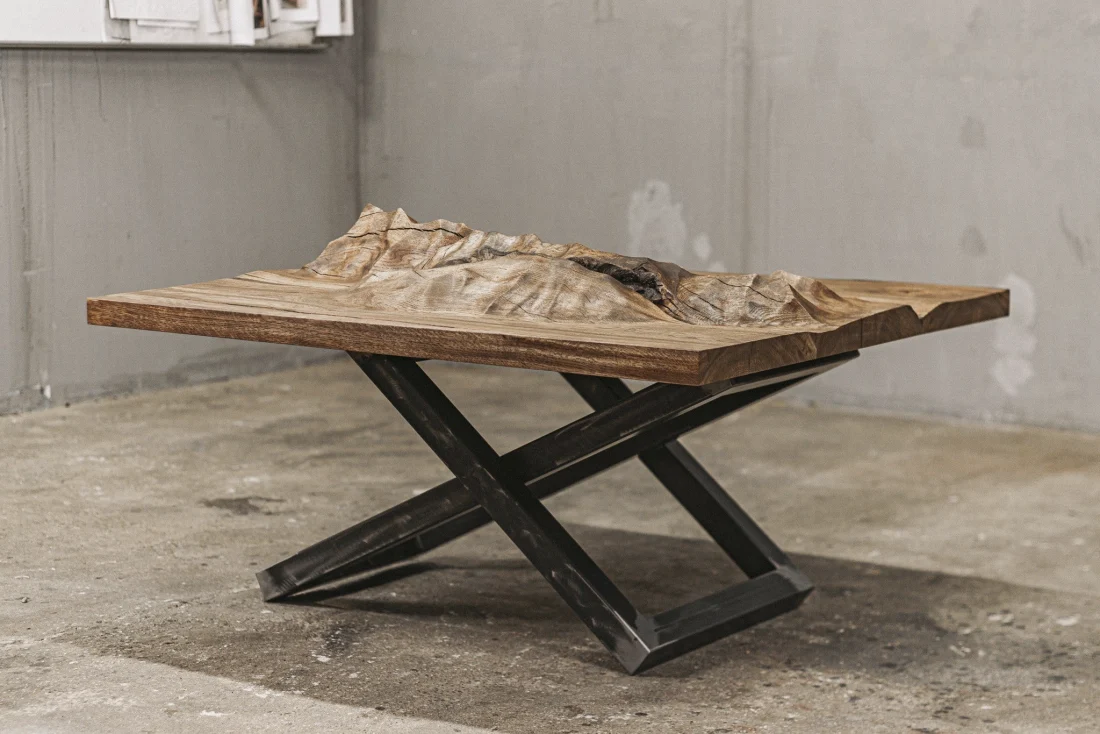
Granite valleys wear their history in cracks and weathered faces, and this table's top does something similar: a live-edge oak slab, its surface textured and burled, with veins of resin run through wherever the wood had split.
Black steel legs, bent into a sharp V on each end, hold it with no stretcher bar breaking up the view underneath. The resin is functional as much as decorative — it stabilizes a slab that would otherwise be too fractured to use as a tabletop, and it catches light differently than the oak around it. Centered in front of a sofa, it reads as one solid piece of landscape brought indoors rather than a table built to look rustic. No two tops in the collection show quite the same crack pattern, since no two slabs split the same way.
Bronze catches water light better than almost any other metal, which may be why this table's base looks poured rather than built: a fluid, curved support in a dark bronze-toned finish, holding a clear glass top with nothing else interrupting the shape.
A version in solid oak and tempered glass offers the same silhouette in wood instead of metal. The curve does all the work here — there is no straight line anywhere in the base, and the glass top lets that shape stay visible from above as well as from the side. It reads sculptural first and functional second, which suits a room where the coffee table is meant to be looked at nearly as often as it is used.
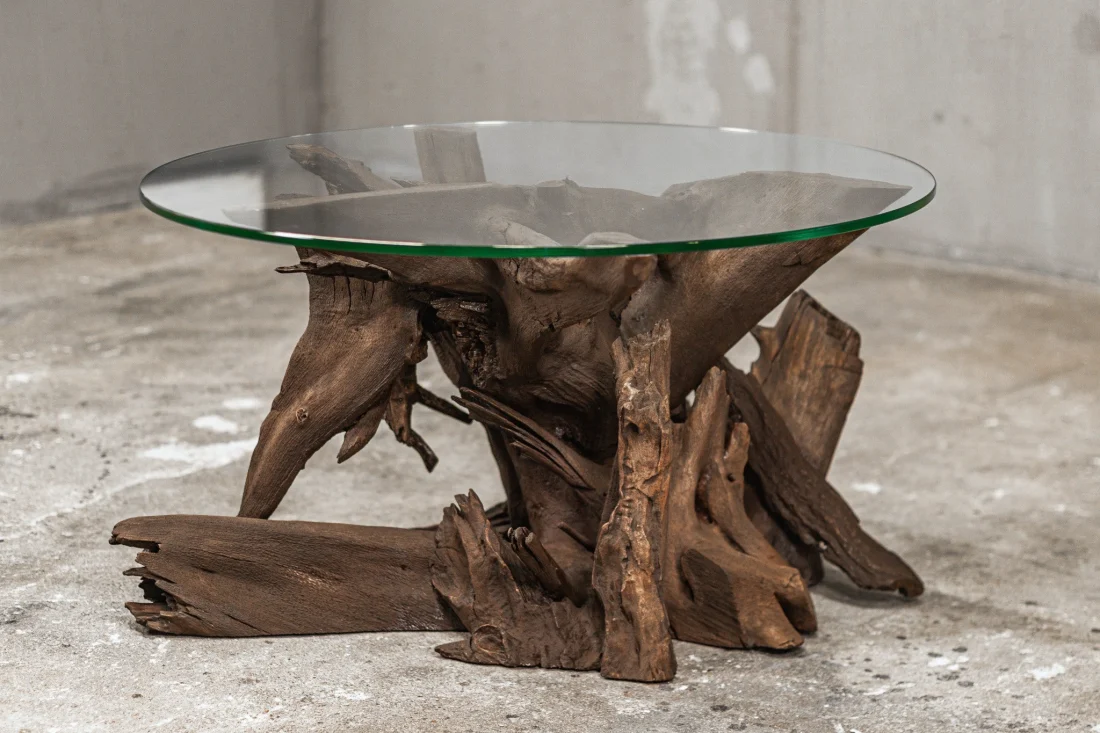
Roots tangle at the surface in wetlands like these, more visible above ground than below it, and this table's base copies that exact form: reclaimed root and branch wood, left in its raw tangled shape, topped with a clear glass slab that lets the whole structure show through.
No two bases are shaped quite the same, since no two root systems ever are. A version in solid oak or poured concrete trades the tangle for a smoother column, for a room that wants the same silhouette with less texture. Either way, the glass is the point: it turns what would be a heavy base into something you can see clean through, table and root both on display at once. It works best where there is room to walk around it, since the base rewards a look from more than one angle.
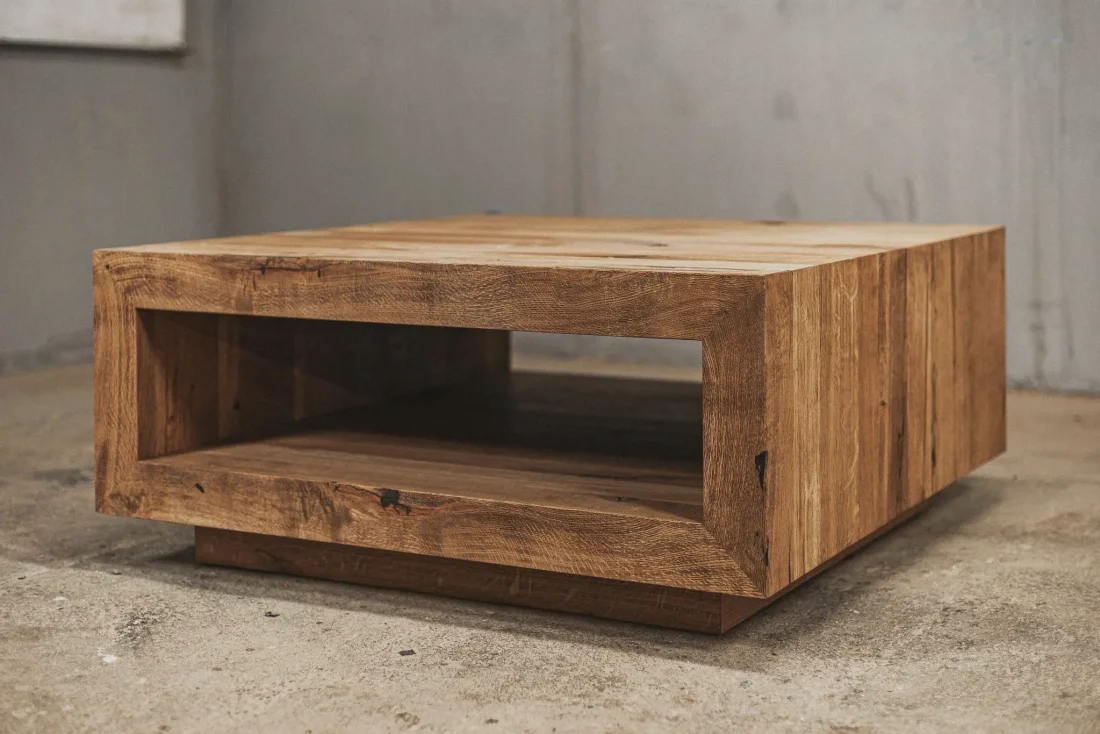
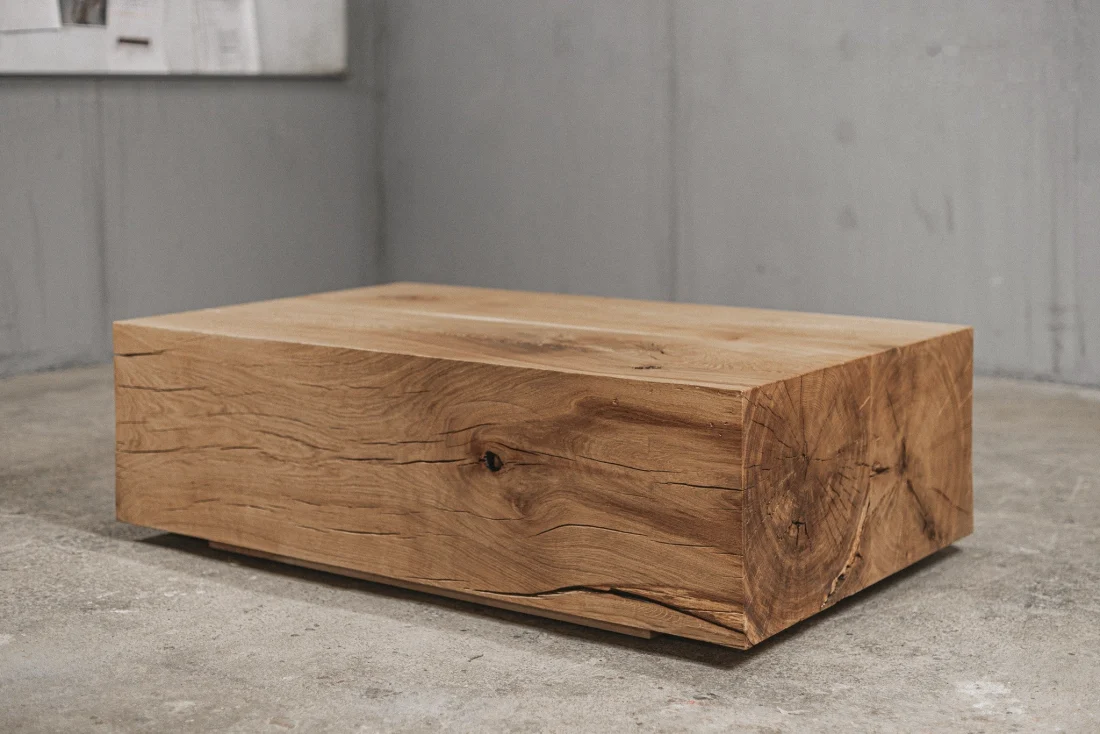
A single block of oak, left mostly as it was cut, does not need much explanation, and this table does not offer much: a rectangular mass of solid wood, corners rounded slightly, a natural crack in the grain left open rather than filled.
Some versions rest that block directly on the floor; others lift it onto a black steel frame at standard coffee-table height. There are no drawers, no shelf, no second material competing with the oak. It works as the one heavy, quiet object in a room otherwise full of lighter furniture — something a room can be arranged around rather than something arranged to fit a room. Sit on it, put your feet on it. The wood can take either.
Camargue takes its name from a delta where rivers braid and tangle before reaching the sea, which is exactly what the base of this table looks like: a knot of oak root, left in its raw, twisting form and simply sealed rather than shaped.
A round sheet of glass rests directly on top of it, thick enough to feel permanent, thin enough to disappear and let the root show through whole. There is only the one table in the collection, and there needs to be only one — no two roots grow alike, so no two ever look quite the same. It works as a centerpiece more than a work surface, something to set a drink on while you study what is actually holding it up.
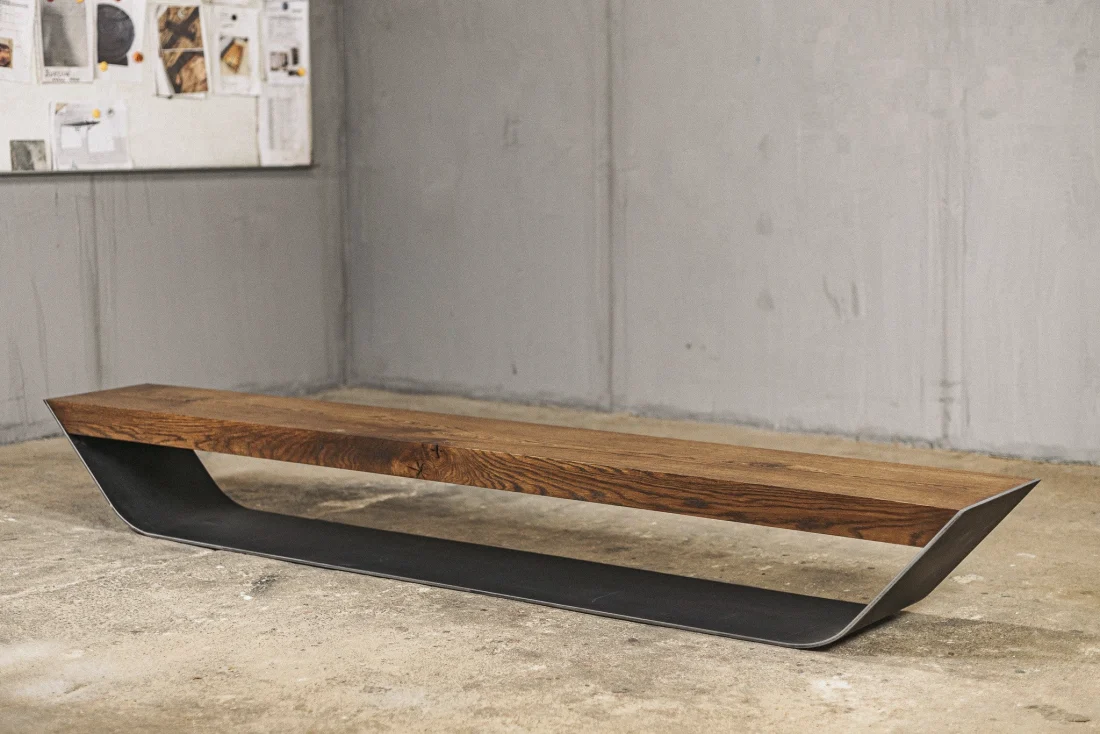
Halifax was built by shipwrights, and this table's base looks pulled straight from that trade — a long, curved black steel form like the hull of a boat, holding up a live-edge oak top that keeps the natural, uneven line of the tree it came from.
Two sizes make up the collection, the sculptural steel base a constant while the oak top varies in length. The wood is left with its bark-edge silhouette intact along one side, a clear contrast to the smooth, engineered curve of the base beneath it. Set as a coffee table, it works as a genuine centerpiece — something to walk around and look at from more than one angle rather than a surface people forget is there.
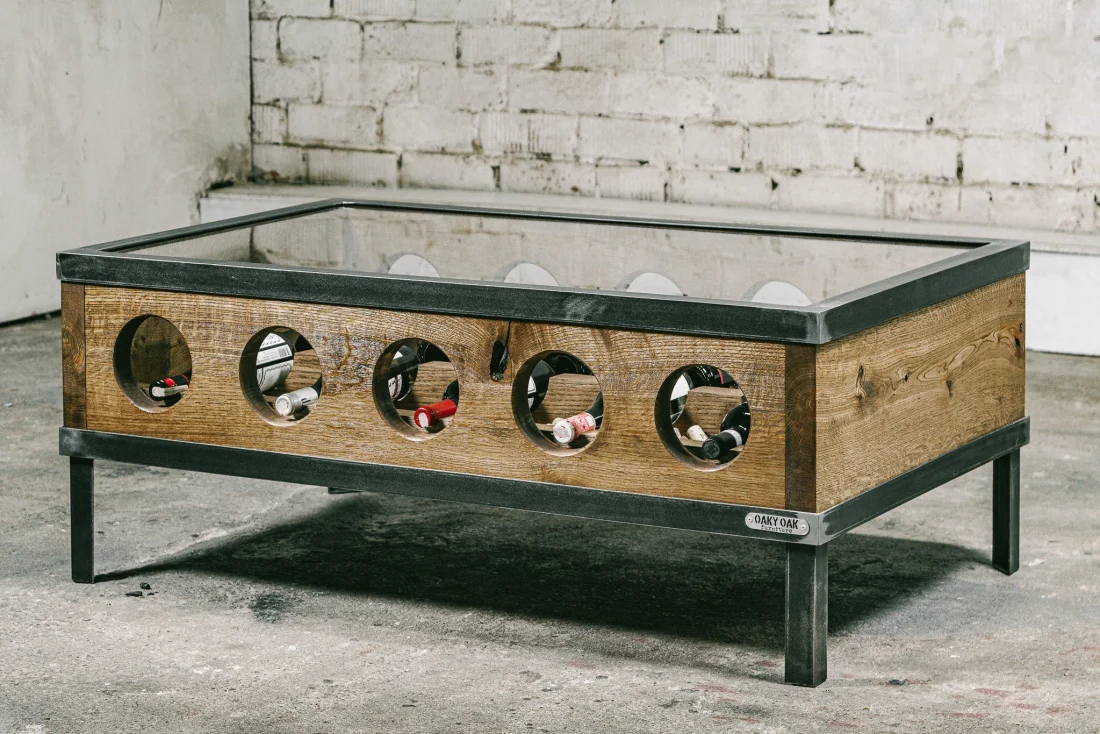
Rivets and gauges built this city's ships and its reputation, and this table borrows both: a black steel and glass frame with round dial faces set into the side panels, like instruments salvaged from an old engine room.
A wood shelf sits below the glass top, burnt oak or natural depending on the finish, gold-toned steel on one version instead of black. The dials do not tell you anything useful — they are decorative, not functional — but they give the piece a presence a plain glass table would not have. It suits a room already leaning industrial, brick or exposed duct work overhead, where a coffee table can afford to look like salvage rather than furniture. The glass top keeps the whole assembly from feeling heavier than a coffee table should.
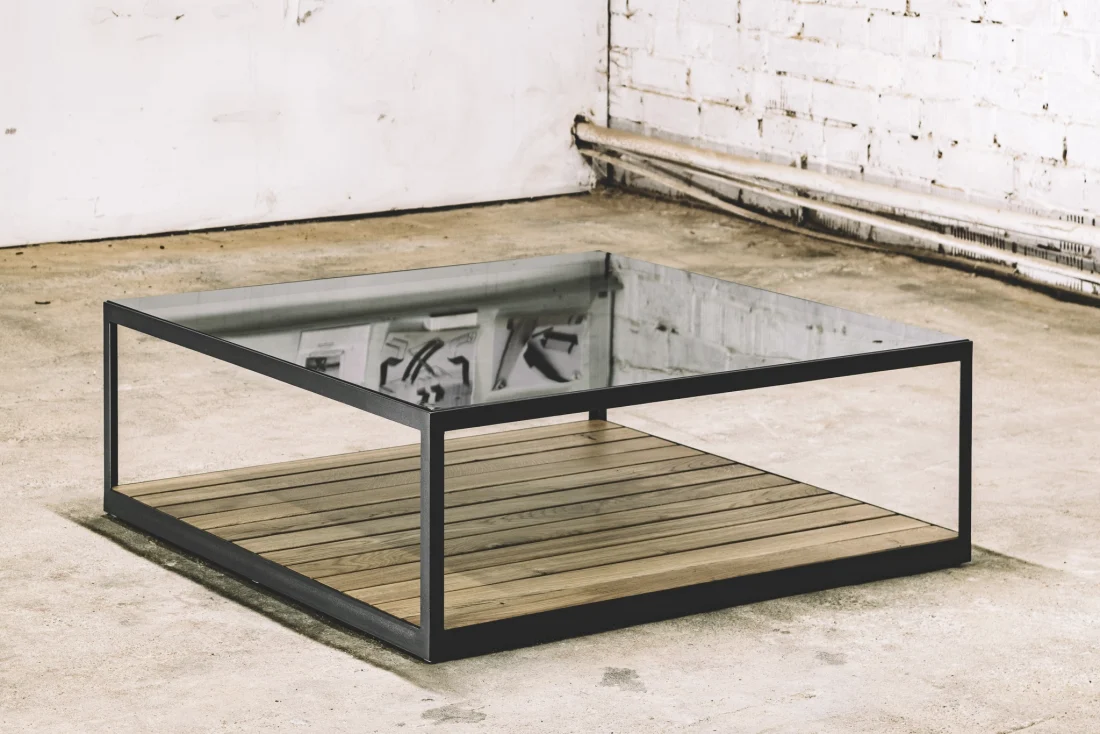
Loft windows in old steel-frame buildings let this city's furniture borrow the same materials: a black steel frame here, glass top set flush into it, with a slatted oak shelf underneath doing double duty as a display surface.
Some versions swap the black frame for gold, or trade natural oak for a warmer walnut tone. The glass keeps the piece visually light despite the steel structure underneath — you see through the top to the shelf below rather than losing that space to a solid slab. It works in a room that wants an industrial edge without the bulk that usually comes with it, useful in an apartment where floor space matters more than statement. The shelf underneath does real work too, holding magazines or a stack of coasters within easy reach of the sofa.
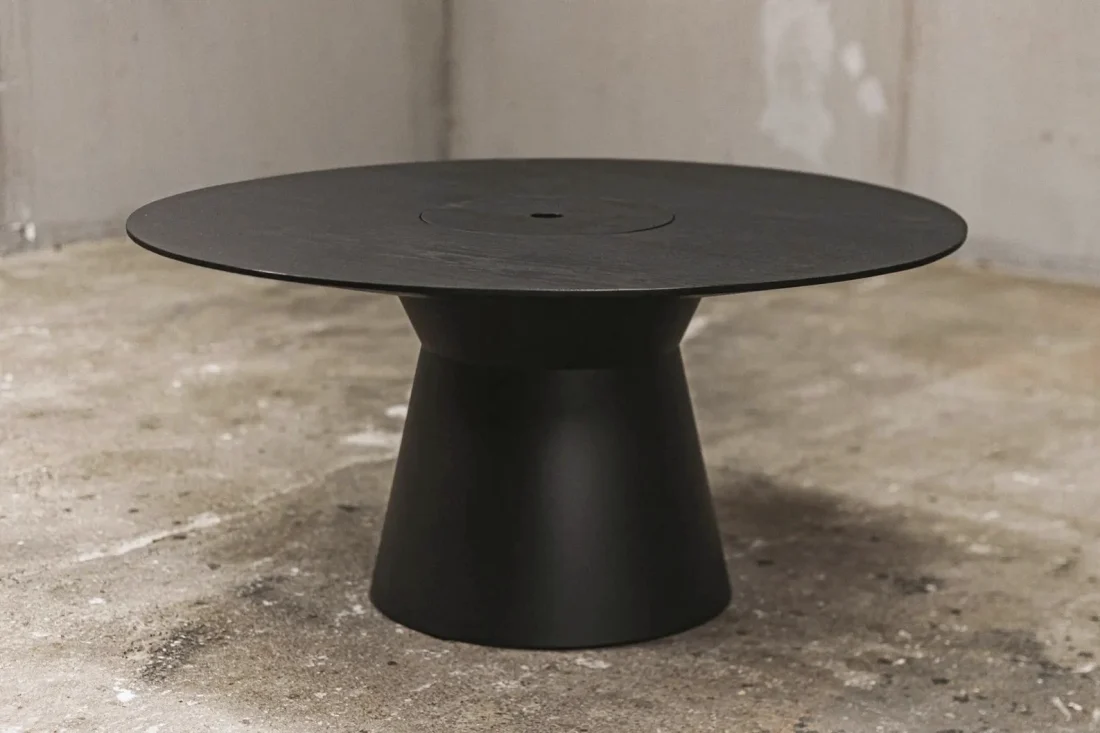
Matte black paint on a precision-built machine reads differently than gloss does — quieter, more serious — and this table's pedestal base borrows that same finish: a solid black cylindrical support, tapering slightly, holding up a round top in solid oak, sometimes stained black to match.
There is no visible seam between base and top. The single-pedestal design means no legs to work around, which matters more than it sounds like in a small room where every table leg is something to step past. It suits a minimal room that already trusts a little negative space — one dark, quiet object doing the job four legs would otherwise do. The finish resists fingerprints better than a glossy black would, which matters for a piece touched daily.